
P&P-HVD
Automatic supply of pick-and-place robots with self-adhesive parts in high-throughput applications.
What Is the P&P-HVD?
The P&P-HVD / RL200 automatically supplies pick-and-place robots with self-adhesive parts for high-throughput applications. Parts are fed from a roll or directly from a box, with multiple rows possible side by side on the liner.
- Feeds directly from roll or box
- Multi-lane die-cut dispensing
- Prepared for camera-based vision monitoring
- RL200 variant available for rigid, non-flexible parts
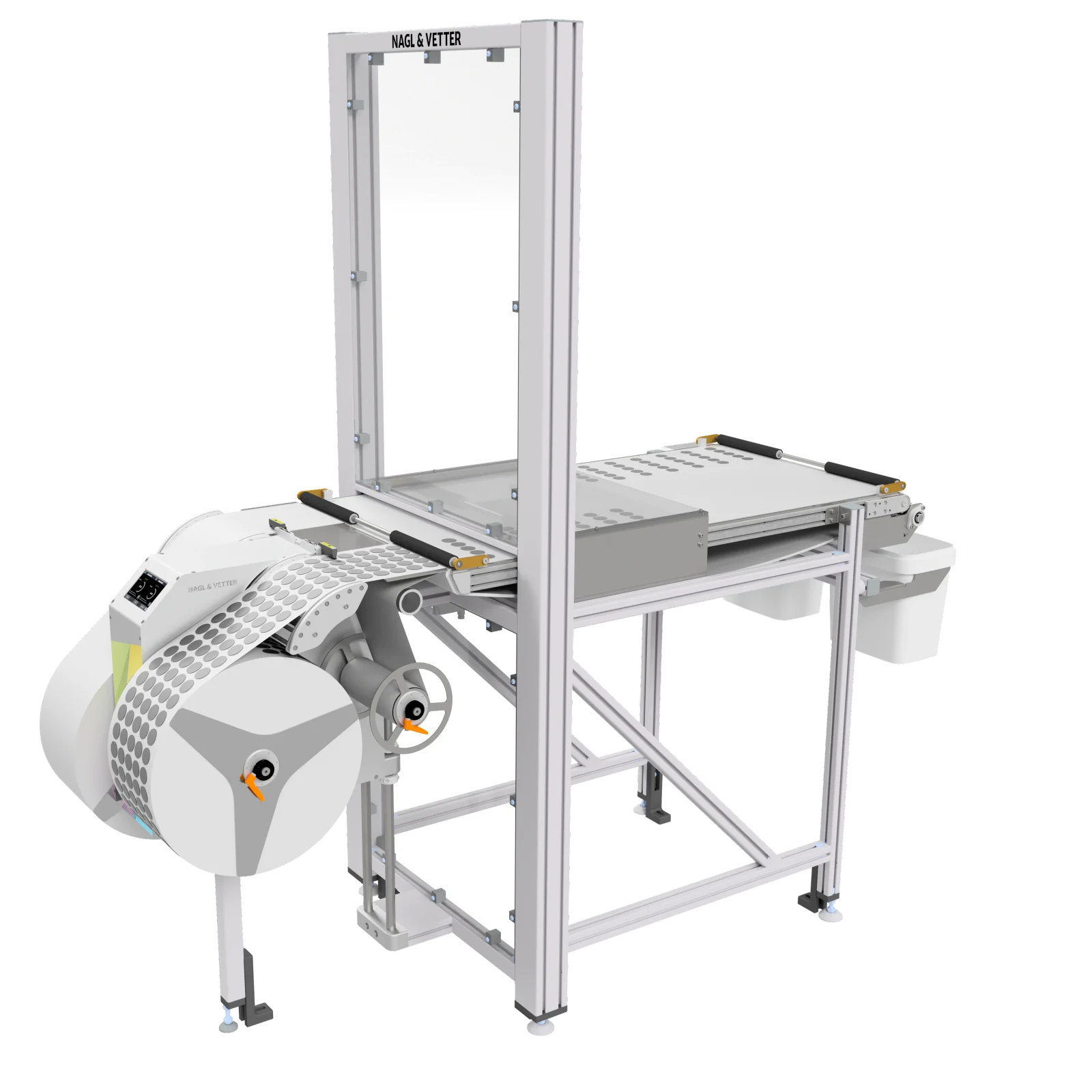
STATUS INFORMATIONMULTI-LANE
DIE-CUT DISPENSINGPREPARED FOR
CAMERA MONITORING
How Does the P&P-HVD Use the Workpiece-Change Window?
The P&P-HVD doesn't wait for one pick to finish before preparing the next. It uses the short window created by every workpiece change to get ahead: reloading the next rows, measuring their position, and — tool-dependent — even starting the first picks, all before the next workpiece reaches its processing position.
01
Workpiece change begins
The next body or part enters its station.
02
Next rows are reloaded
The conveyor advances the die-cuts needed for the next process into the pick zones.
03
Camera measures positions
Once stopped, all part positions in the pick zones are measured in a single pass.
04
Robot starts immediately
Depending on the tool, first picks can even begin during the change — so the robot is ready the moment the next workpiece arrives.
How Fast and Accurate Is the P&P-HVD?
0.2–0.4 s
Typical cycle time per die-cut
Because the next rows are already measured and waiting, the robot never pauses between picks for the next part to be supplied — it picks continuously, guided by precise camera-based position data. Actual throughput depends mainly on the robots and gripper tooling used, and scales further with additional robots or grippers as demand grows.
- Continuous status information on the touch display
- Mechanical interface for a stationary vision camera
- Precise, camera-based position data for continuous picking
- Scales with additional robots and gripper tooling
What Makes the Pick-and-Place Transfer Reliable?
A standard conveyor belt can make self-adhesive die-cuts stick too firmly for a clean pick. The P&P-HVD uses a special low-tack belt instead, available in white or dark blue — whichever gives the vision camera the best contrast for the part being measured. Camera selection and integration remain the responsibility of the customer or integrator; Nagl & Vetter recommends SensoPart systems, though other vision brands can be used as well.
- Low-tack belt surface for clean suction pick-up
- White or dark blue belt color for camera contrast
- Camera mounted via a dedicated interface on the P&P-HVD
- SensoPart systems recommended; other vision brands supported
Belt color, selected for camera contrast
How Is High System Availability Achieved?
Two feed sides carry identical material; if the active side runs empty or faults, the system switches over automatically, with fill levels, readiness, active side, and fault codes reported to the higher-level control. The conveyor can also be extended with multiple separated pick zones along its length, letting a single P&P-HVD continuously supply several robots with the same part type — without a dedicated feed system for each one. The system integrates into a robot cell's safety fence or runs as a free-standing machine.
- Two redundant feed sides with automatic switchover
- Status, fill level, and fault codes reported via fieldbus
- Multiple separated pick zones let one unit serve several robots
- Integrates into robot-cell safety fencing, or runs free-standing
How Does the System Handle Missing or Faulty Parts?
Missing rows are automatically skipped, as long as too few aren't missing at once. The camera only ever reports positions of parts that are actually present and intact — positions of missing or faulty die-cuts are never sent to the robot, which picks strictly in the defined priority order. Surplus die-cuts, or faulty ones the robot deliberately leaves ungripped, can be automatically removed at the end of the conveyor.
- Automatic skip logic for missing die-cuts
- Robot receives only valid part positions, picked by priority
- Optional passive or driven reject brushes at the conveyor end
- Waste bin for automatically ejected parts
How Is Material Changed Over Safely?
The material feed can sit entirely outside the robot cell, so rolls can be changed or refilled without ever entering the robot's working area. Feed and manual controls stay on the outside of the cell wall, while the conveyor runs through a tunnel-style cover and a matching slot in the wall into the cell — keeping material handling and the robot's workspace physically separated.
Outside the cell
Operator access
Cell wall
Conveyor pass-through
Inside the cell
Robot workspace
- Material changeover stays entirely outside the robot's working area
- Tunnel-style cover guides the conveyor through the cell wall
- Material handling and robot workspace stay physically separated
Which Materials Can Be Processed?
Self-adhesive die-cuts can be supplied and processed directly from a box or from a roll, depending on the model. Real-world applications include automotive body hole covering, foam pads on traction-battery components, and self-adhesive plastic parts, extending beyond classic roll-liner automotive use cases.
- Die-cut diameter adjustable up to 90 mm
- Standard liner width 30–200 mm
- Material roll diameter up to 400 mm, core 3" or 6"
- Also proven for foam pads and self-adhesive plastic parts beyond automotive
Custom example: for lightweight foam pads, a version handling liner widths up to 300 mm and roll diameters up to 500 mm has already been realized — custom executions beyond standard dimensions can be reviewed case by case.
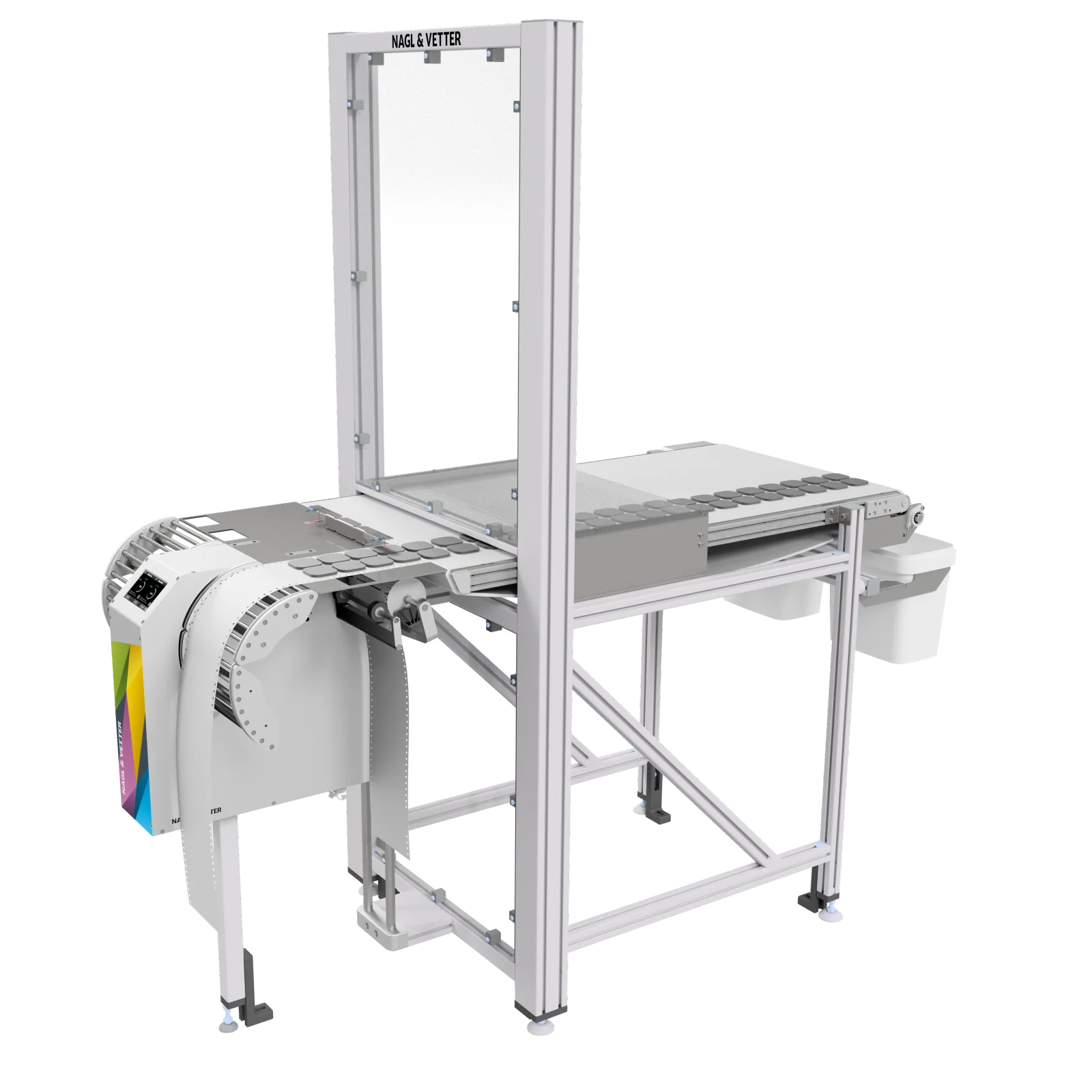
How Does the RL200 Handle Rigid, Non-Flexible Parts?
Self-adhesive plastic parts and other rigid die-cuts are difficult to wind onto a roll. For these, the RL200 variant feeds from a liner with continuous transport perforations along both edges, packed accordion-folded in a box. The P&P-HVD pulls the liner automatically out of the box and feeds it directly — no manual unpacking required. This solution is already running in series production, opening up automation for parts that were previously often applied by hand.
- Continuous transport perforations on both liner edges
- Liner is pulled automatically from an accordion-folded box
- No manual unpacking of the liner required
- Already proven in series production
How Is the P&P-HVD Integrated and Parametrized?
Relevant process data is exchanged with the higher-level control via PROFINET or EtherNet/IP — material status for both sides, readiness, active feed side, and fault codes flow out, while feed and conveyor commands flow in. Settings can be loaded via fieldbus and managed centrally, then distributed across multiple units. Because the device's internal functions don't need to be individually controlled from above, programming, validation, and commissioning effort stays low.
Technical Specifications
| Supply voltage | Var. A: 100–240 V AC, 2.6 A, 50/60 HzVar. B: 24 V DC, 8 A |
| Dimensions | 804 × 1985 × 1750 mm (W × H × D) |
| Weight | 125 kg / 120 kg |
| Liner width | Standard range 30–200 mm |
| Max. roll diameter | 400 mm |
| Core diameter of material rolls | 3" (76.2 mm) or 6" (152.4 mm) |
| Die-cut diameter | adjustable up to 90 mm |
| Material feed | Two feed sides |
| Typical cycle time per die-cut | 0.2 s / 0.4 s |
| User interface | 5-inch LCD, PCAP touch, glass surface |
| Fieldbus interface | PROFINET / EtherNet-IP |
| Operating temperature range | 10–50 °C |
Built for High-Throughput Series Production
The P&P-HVD / RL200 is deployed at OEMs and suppliers worldwide wherever pick-and-place robots need a continuous, high-speed supply of self-adhesive parts.
Patented in Europe and the USA
P&P-HVD for Your Line
We will discuss with you how the P&P-HVD can be integrated into your robot cell and material flow.
Get in Touch